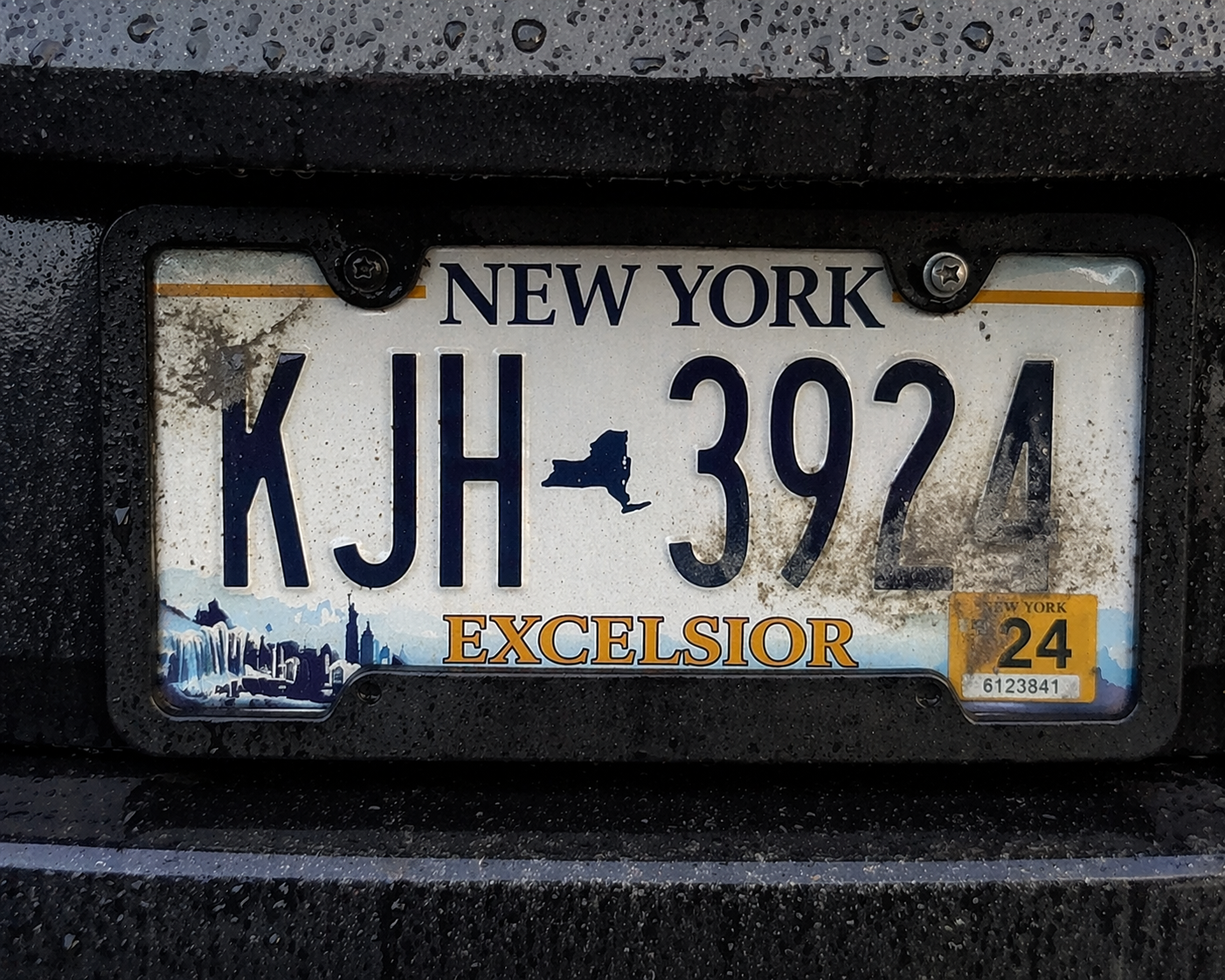
VTL § 402-b — Obscured & Obstructed License Plates
If you are charged with driving in New York with an obscured or obstructed license plate, you will be prosecuted under Vehicle & Traffic Law § 402-b. This statute makes it unlawful to cover, coat, or otherwise obstruct the visibility of a license plate. While many motorists consider this a minor ticket, repeat offenses can lead to severe consequences. Under VTL § 510(4-h)(a), three convictions within five years can result in a ninety-day suspension of your vehicle registration.
- Fine: Typically up to $200 per violation
- Surcharge: Mandatory state surcharge (varies by court)
- Dismissal Option: If corrected by the next business day and proof is shown to the court, the ticket may be dismissed
- Registration Suspension: Under VTL § 510(4-h)(a), three convictions within five years can result in a 90-day suspension of the vehicle’s registration
Statute
The exact wording of the relevant sub-statute is:
§ 402-b. Obscured and obstructed license plates.
1. If any vehicle is driven or operated on a public highway with license plates that are obscured or obstructed in violation of subparagraph (ii), (ii-a), or (iii) of paragraph (b) of subdivision one of section 402 of this article, a police officer may issue a summons unless the defect is corrected in the officer’s presence.
2. A summons for such violation may be dismissed by the court if the defect is corrected not later than one-half hour after sunset on the next business day following issuance of the summons, and proof of correction is provided.
Additional penalties found in VTL § 510(4-h)(a):
§ 510. Suspension, revocation and reissuance of licenses and registrations.
4-h. Suspension of registration for covering license plates with a license plate cover or material appearing to be a number plate or obscuring license plates with any material or substance. (a) Upon receipt of a notification from a court or an administrative tribunal that an owner of a motor vehicle has been convicted three or more times within a period of five years of a violation of subparagraph (ii), (ii-a) or (iii) of paragraph (b) of subdivision one of section four hundred two of this chapter not arising out of the same incident, the commissioner or the commissioner's agent may suspend the registration of the motor vehicle involved in such violation for a period of ninety days. The commissioner may, in the commissioner's discretion, deny a registration or renewal application to any other person for the same vehicle and may deny a registration or renewal application for any other motor vehicle registered in the name of the applicant where the commissioner has determined that such registrant's intent has been to evade the purposes of this paragraph and where the commissioner has reasonable grounds to believe that such registration or renewal will have the effect of defeating the purposes of this paragraph. Such denial shall remain in effect only as long as the suspension entered pursuant to this paragraph remains in effect.
Understanding VTL § 402-b & § 510(4-h)(a)
VTL § 402-b is a provision of New York’s Vehicle and Traffic Law that addresses obscured and obstructed license plates. It prohibits drivers from operating a motor vehicle with plates that are covered, coated, or otherwise obstructed from clear view. While at first glance this may appear to be a minor ticket, the statute is designed to ensure that law enforcement, toll readers, and red-light cameras can properly identify vehicles on the road.
Many motorists may not realize that this violation carries escalating penalties if it occurs repeatedly. Under VTL § 510(4-h)(a), three convictions for obscured or obstructed plates within a five-year period can result in a ninety-day suspension of the vehicle’s registration. This makes multiple offenses far more serious than a simple fine and shows the legislature’s intent to deter repeat violations.
Fighting an Obscured or Obstructed Plate Charge in New York
Being charged under New York’s license plate obstruction statute is not something to take lightly. While many motorists view it as a minor traffic ticket, you still have the right to contest the charge. Entering a Not Guilty plea is not an admission of guilt or innocence—it is the legal step that requires the prosecution to prove the case beyond a reasonable doubt. By exercising this right, the evidence, the officer’s discretion, and the circumstances of the stop can all be reviewed in court.
Although a first-time violation may be dismissed if corrected quickly, repeat convictions can lead to much more serious consequences. Under VTL § 510(4-h)(a), three convictions for obscured or obstructed license plates within five years can result in a ninety-day suspension of your vehicle registration. This penalty can create significant hardship, particularly for those who rely on their vehicles for work or family responsibilities.
An experienced traffic attorney can provide critical support in navigating these proceedings. Counsel can assess the ticket, determine whether the officer followed proper procedure, and explore defenses that may lead to dismissal or reduction. They can also negotiate with prosecutors on your behalf to help protect your license, registration, and driving record.
Benjamin Goldman Law Office — NY Traffic Attorneys
The Benjamin Goldman Law Office provides legal representation for motorists charged under VTL § 402-b, also known as Obscured and Obstructed License Plates. This statute makes it a violation to drive with plates covered, coated, or otherwise obstructed from clear view. While many drivers view this as a minor ticket, repeat violations carry serious consequences. Under VTL § 510(4-h)(a), three convictions within five years can result in a ninety-day registration suspension. Our office focuses on defending motorists across New York against traffic and vehicle-related violations, including license plate obstruction charges.
The Benjamin Goldman Law Office is available to assist drivers facing VTL 402(b) charges anywhere in New York- for example we cover cases in Montauk, Glens Falls, Delhi, Massena, Corning, Canandaigua, and even Olean- anywhere and everywhere in New York, if you have a case, we've got you covered!
CALL NOWOther Traffic Violations We Handle
Community Discussion
Questions? Thoughts? Let us know down below!
Can I legally be stopped because my temporary Arizona tag was inside a plastic cover and the officer said he could not see the state or issue information? When I showed him the information on the back, he said the cover obstructed the tag. I was ultimately ticketed for having no insurance, which I did not have then, and for a scented air freshener hanging from my mirror. Was there a valid reason for the stop, or were my rights violated?
What am I likely to have to pay, and does this ticket put points on my license? I was stopped for doing 85 in a 65. The officer wrote me up for having a dirty license plate instead, although the ticket also lists my speed and says general 101a. I’m trying to find out what the charge will cost and whether I’ll get license points.
The exact charge is not clear from the information provided. Have a traffic-ticket attorney look over the ticket papers so you can get more specific advice. Many attorneys provide an initial consultation at no cost.
What should I do about a ticket for having a dirty license plate? A state trooper stopped me for speeding, but instead of writing me for speeding, he gave me a ticket because my plate was dirty.
This ticket does not carry points. I would plead guilty and pay the fine.
An officer gave me a ticket for my dealer license-plate frame instead of a speeding ticket because I have a clean record. If I enter a not-guilty plea for the plate obstruction charge, do I need to appear in court?
If you decide to plead guilty to the obstructed-plate citation, you do not need to appear in court.
If you were injured in an accident, you can contact the Sternberg Injury Law Firm and they can advise you of your options
Disclaimer: All the content of this website has been prepared by Benjamin Goldman Law Office PC for informational purposes only and does not constitute legal advice. The information on this website shall not be construed as an offer to represent you, nor is it intended to create, nor shall the receipt of such information constitute, an attorney-client relationship. Our hope is that you will find the information useful and informative, and we would be happy to communicate with you and answer any questions you may have about our legal services. Readers should not act upon the information on this website, or decide not to act based upon the information on this website, without first seeking appropriate professional counsel from an attorney licensed in the home state of the drivers license of the person who received the relevant traffic citation.
Benjamin Goldman Law Office
When a license plate or temporary tag appears irregular or difficult to read, it makes a traffic stop much more likely.