Speeding in New York
Facts, statistics, and penalties.About 29% of U.S. traffic fatalities occur in speed-related crashes. New York enforces speeding with points, fines, and work zone cameras. Know the research, the law, and your options.
Free consultationKey Facts About Speeding
What the data shows, how New York penalizes speeding, and why speed matters for crash severity.
What the Research Shows
NHTSA estimated 39,345 U.S. traffic fatalities in 2024 (a 3.8% decrease from 2023). In 2023, 11,775 deaths—29% of all U.S. motor vehicle fatalities—occurred in speed-related crashes. High speeds reduce reaction time and increase crash energy; IIHS notes that when impact speed goes from 40 to 60 mph, crash energy rises 125%. Sources: NHTSA, IIHS.
NY Law and Penalties
New York uses VTL 1180(a) through 1180(f) for speeding. Points range from 3 to 11 depending on how fast you were going; work zone speeding carries double fines and 8 points (on or after Feb 2026). See VTL 1180 and our VTL 1180(a) and 4-06(a)(1) pages.
Work Zones and Enforcement
FHWA reports that four out of five work zone fatalities are drivers or passengers. NY uses automated work zone cameras; in 2023 over 130,000 work zone speeding tickets were issued. See VTL 1180(f).
Speeding: What the Data Shows
How Many Fatal Crashes Involve Speeding?
NHTSA’s early estimate for 2024 put U.S. traffic fatalities at 39,345—a 3.8% decrease from 2023 and the first time since 2020 below 40,000. In 2023, 11,775 deaths, or 29% of all U.S. motor vehicle fatalities, occurred in speed-related crashes. Source: NHTSA 2024 traffic fatalities estimate.
Based on a nationally representative sample of police-reported crashes, speeding—defined as exceeding the speed limit, driving too fast for conditions, or racing—was involved in 9% of property-damage-only crashes and 14% of crashes with injuries or fatalities in 2023. See NHTSA Crash Report Sampling System (CRSS) and IIHS Speed topic.
What Does Speeding Cost the Economy?
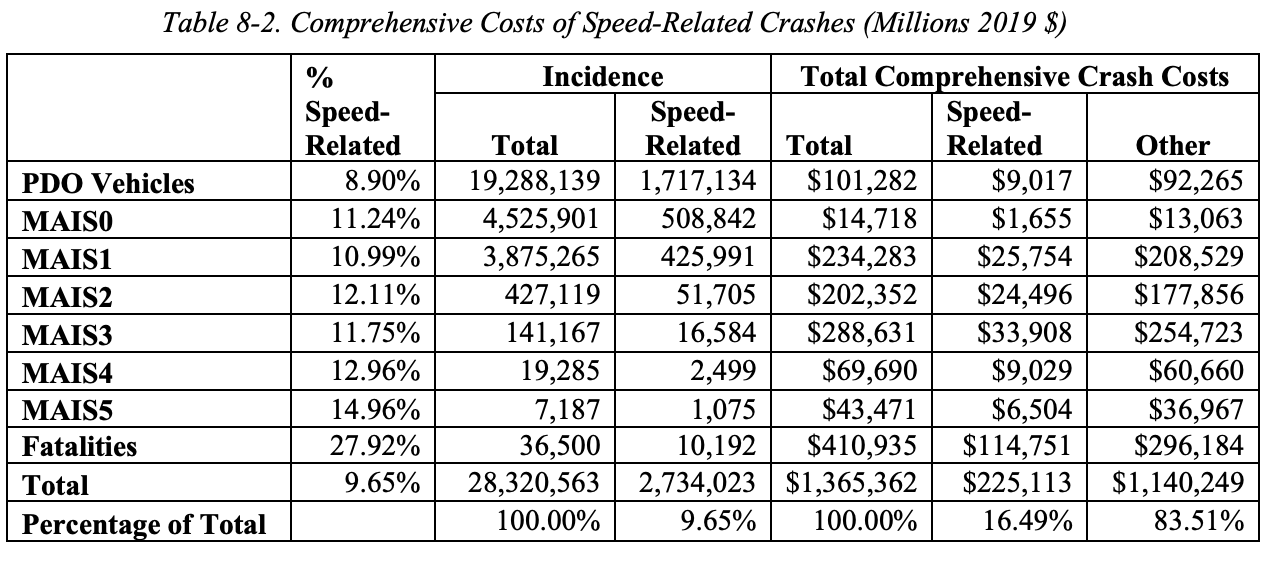
NHTSA estimates the economic cost of speed-related crashes was about $46 billion in 2019 (Blincoe et al., DOT HS 813 403). An earlier NHTSA assessment put the 2010 figure at $59 billion—about 21% of all crash-related economic costs. Total U.S. motor vehicle crash economic cost in 2019 was $340 billion; including quality-of-life valuations, societal harm was nearly $1.4 trillion. Sources: NHTSA 813 403, IIHS.
Why Does Speed Increase Crash Severity?
Speed affects both the likelihood and the severity of crashes. According to IIHS, speed increases crash energy disproportionately: when impact speed goes from 40 to 60 mph (a 50% increase), the force of the impact of the crash increases by 125%. Higher speed also shortens reaction time, lengthens stopping distance, and increases the chance of loss of control in evasive maneuvers. Vehicle structure, restraints, and roadside hardware can manage only so much energy; above that, injury severity rises.
Who Is Most Likely to Speed?
Drivers who speed tend to be younger, and male drivers are more likely than female drivers to speed. In 2023, 20% of male passenger-vehicle drivers involved in fatal crashes were speeding, compared with 12% of female drivers. The proportion of drivers who were speeding in fatal crashes decreased with increasing driver age. Sources: IIHS, NHTSA survey.
In a 2023 AAA Foundation for Traffic Safety survey, 49% of drivers said they had exceeded the speed limit by 15 mph on a freeway in the past month, and 36% reported exceeding the limit by 10 mph on a residential street. See AAA Foundation Traffic Safety Culture Index.
What About Work Zone Crashes?
The Federal Highway Administration (FHWA) reports that four out of five work zone fatalities are drivers or passengers, not workers. Work zone fatalities decreased by 7% from 2021 to 2022 but remain a focus of enforcement. In 2022, 30% of fatal work zone crashes involved commercial motor vehicles, and 21% involved rear-end collisions. See FHWA work zone news.
New York uses automated work zone speed cameras. From April through November 2023, the state issued 133,640 work zone speeding tickets (95,861 in NYSDOT work zones and 37,779 on the Thruway). Tickets are issued to vehicles traveling more than 10 mph over the posted limit in active work zones. Source: NY DMV / GTSC, Governor’s office.
What Is New York Doing About Speeding?
The Governor’s Traffic Safety Committee (GTSC), chaired by the DMV Commissioner, runs statewide enforcement and supports national mobilizations. During one 2023 campaign, law enforcement issued 12,762 speeding tickets out of 70,263 total tickets. NY also conducts Speed Awareness Week and uses work zone cameras. See NY DMV GTSC release (speeding tally in table).
| Violation | Tickets |
|---|---|
| Speeding | 12,762 |
| Distracted Driving | 2,612 |
| Impaired Driving | 1,249 |
| Other | 50,959+ |
| Total | 70,263 |
Source: NY DMV / GTSC.
What Are the Penalties for Speeding in New York?
Penalties depend on which subsection of VTL 1180 you are charged with. The following is a summary; see the NY points chart and NY DMV for official details.
- VTL 1180(a) — Speed not reasonable and prudent: up to $150 fine, 3 points, $88 or $93 surcharge. See VTL 1180(a).
- VTL 1180(b), (c), (d) — Exceeding posted limit: points and fines increase with mph over the limit. For example, 1–10 mph over = 3 points; 11–20 = 4 points; 21–30 = 6 points; 31–40 = 8 points; over 40 = 11 points. Fines can be several hundred dollars or more. See VTL 1180(b), 4-06(a)(1) NYC, 1 mph speeding.
- VTL 1180(f) — Speeding in a work zone: double fines, 8 points for violations on or after February 16, 2026. A second conviction (at any time) results in a 60-day license suspension. See VTL 1180(f) work zone.
- Driver Responsibility Assessment (DRA): Six or more points in 18 months triggers the DRA: $300 plus $75 per point over six. See Driver Responsibility Assessment and how long points last.
| Violation / mph over | Points |
|---|---|
| 1180(a) — not reasonable & prudent | 3 |
| 1–10 mph over limit | 3 |
| 11–20 mph over | 4 |
| 21–30 mph over | 6 |
| 31–40 mph over | 8 |
| Over 40 mph | 11 |
| 1180(f) work zone (on/after Feb 2026) | 8 |
Source: NY DMV, VTL 1180. Confirm current points with DMV.
What Can You Do to Stay Safe and Avoid Tickets?
Obey posted speed limits and slow down in work zones and when conditions warrant (weather, traffic, pedestrians). Allow extra time so you are not rushed. NHTSA and IIHS emphasize that speed limits and enforcement save lives. In New York, if you receive a speeding ticket, you may be able to fight it with the help of a lawyer; a reduction or dismissal can avoid points and the Driver Responsibility Assessment. See fees and expectations for hiring a traffic lawyer.
What You Need to Know
Four key takeaways about speeding and New York law.
What the Data Shows
29% of U.S. traffic fatalities occur in speed-related crashes. Higher speed increases crash energy and severity. Economic cost of speed-related crashes was about $46 billion in 2019 (NHTSA).
Who Speeds
Younger drivers and male drivers are more likely to speed. In fatal crashes, a higher share of male drivers were speeding than female drivers; the share decreases with age.
NY Penalties
Points range from 3 to 11; work zone speeding is 8 points and double fines. Six or more points in 18 months triggers the Driver Responsibility Assessment.
What You Can Do
Obey limits, slow in work zones, allow extra time. If you get a ticket, a traffic lawyer may be able to help you fight it and avoid points and the DRA.
Common Questions
How many fatal crashes involve speeding?
NHTSA estimated 39,345 U.S. traffic fatalities in 2024. In 2023, 11,775 deaths, or 29% of all U.S. motor vehicle fatalities, occurred in speed-related crashes (NHTSA). Speeding was involved in 9% of property-damage-only crashes and 14% of crashes with injuries or fatalities (NHTSA CRSS).
What does speeding cost the economy?
NHTSA estimates the economic cost of speed-related crashes was about $46 billion in 2019 (Blincoe et al., DOT HS 813 403). Earlier NHTSA work put the 2010 figure at $59 billion (21% of all crash-related economic costs).
Who is most likely to speed?
Drivers who speed tend to be younger; male drivers are more likely than female drivers to speed (IIHS, NHTSA). In 2023, 20% of male passenger-vehicle drivers in fatal crashes were speeding, compared with 12% of female drivers; the proportion decreased with age (IIHS).
What are the penalties for speeding in New York?
Penalties depend on the subsection. VTL 1180(a) (reasonable and prudent): up to $150, 3 points. VTL 1180(b)–(d) (exceeding posted limit): 3–11 points and higher fines for greater mph over the limit. VTL 1180(f) work zone: double fines, 8 points (on or after Feb 2026), 60-day suspension for a second conviction. Six or more points in 18 months triggers the Driver Responsibility Assessment. See NY DMV and VTL 1180; our VTL 1180(a) and points chart.
How many points is a speeding ticket in New York?
Points range from 3 to 11 depending on how fast you were going. VTL 1180(a) is 3 points; 1–10 mph over is 3 points; 11–20 is 4; 21–30 is 6; 31–40 is 8; over 40 is 11. Work zone speeding [VTL 1180(f)] is 8 points for violations on or after February 2026. See the NY DMV points chart and how long points last.
What is speeding in a work zone in New York?
VTL 1180(f) prohibits exceeding the posted speed limit in a work zone when workers are present. Penalties include double fines and 8 DMV points (on or after Feb 16, 2026). A second conviction at any time results in a 60-day license suspension. NY also uses automated work zone cameras that issue tickets by mail. See VTL 1180(f) work zone and NY DMV.
What can you do to avoid speeding tickets and stay safe?
Obey posted limits, slow down in work zones and when conditions warrant (weather, traffic). Allow extra time so you are not rushed. In NY, fighting a ticket with a lawyer can sometimes result in a reduction or dismissal, avoiding points and the Driver Responsibility Assessment.