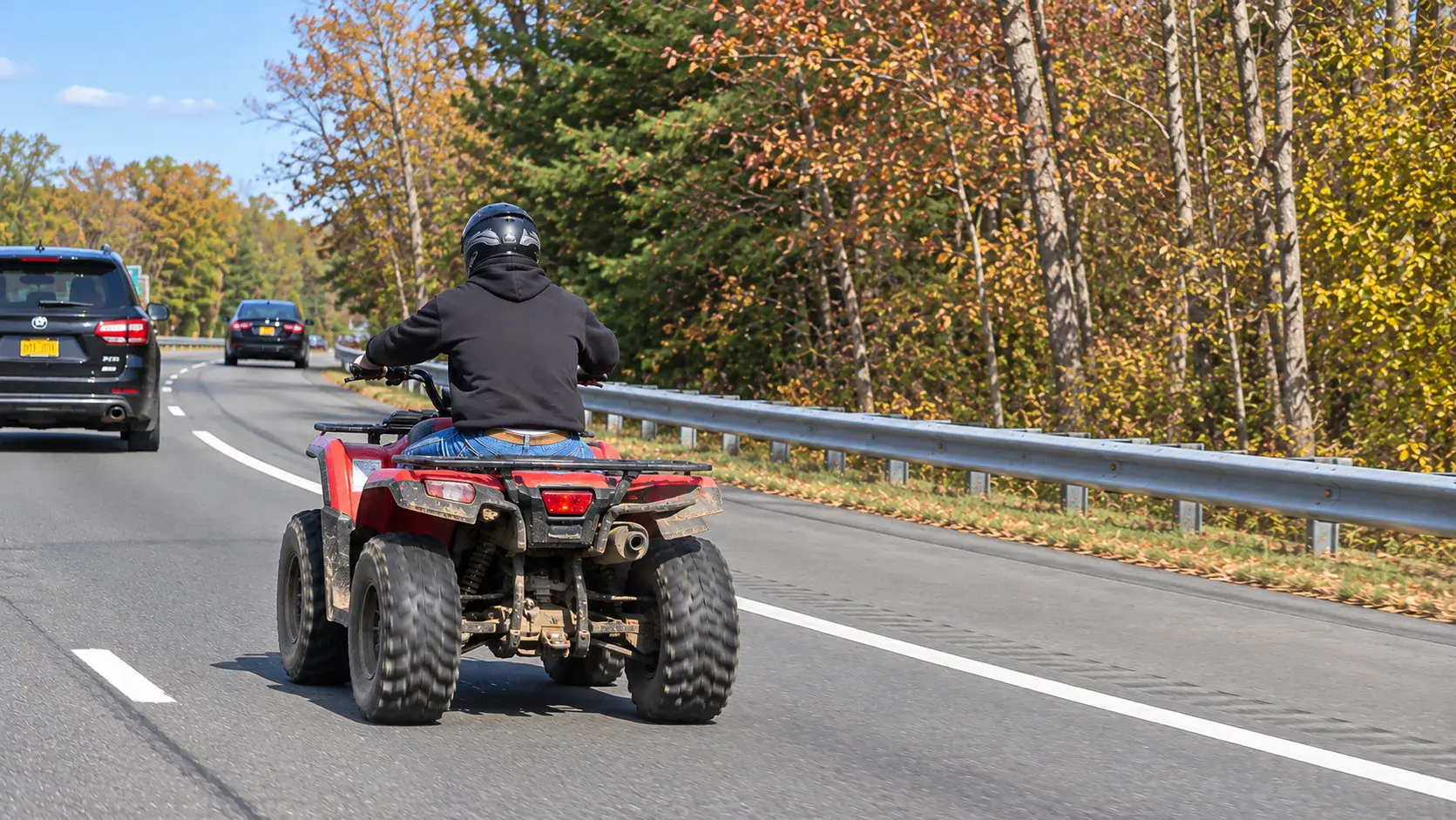
Vehicle & Traffic Law § 2403(1) - Operating ATV on Highway
Vehicle & Traffic Law ("VTL") § 2403(1) applies to anyone who operates an all-terrain vehicle ("ATV") on a highway that is not designated and posted for ATV travel. VTL § 2403(1) also covers whether an ATV crossing is made directly, safely, and with the required stops, yielding, and lights.
Text of VTL § 2403(1)
The official wording of VTL § 2403(1) is:
1. Highways. No person shall operate an ATV on a highway except as provided herein.
(a) An ATV may make a direct crossing on a highway other than an interstate highway or a controlled access highway, provided:
(i) the crossing is made at an angle of approximately ninety degrees to the direction of the highway and at a place where no obstruction prevents a quick and safe crossing;
(ii) the vehicle is brought to a complete stop before crossing the shoulder or main travelled way of the highway;
(iii) the driver yields the right-of-way to all oncoming traffic that constitutes an immediate hazard;
(iv) in crossing a divided highway, the crossing is made only at an intersection of the highway with another public street or highway, and
(v) if the crossing is made between the hours of one-half hour after sunset to one-half hour before sunrise or in conditions of reduced visibility, only if both front and rear lights are lighted.
(b) An ATV may be operated on any highway which has been designated and posted as open for travel by ATVs in accordance with the provisions of section twenty-four hundred five of this article.
Penalties for a VTL § 2403(1) Ticket
The penalties increase for repeat offenses within the applicable period.
- Fine and surcharge: The first-offense fine is up to $250, plus a mandatory surcharge of $88 (city and district courts) or $93 (town and village courts).
- Jail: Up to 15 days in jail, although jail is highly unlikely in practice.
- Points: VTL § 2403(1) does not carry any points.
Disputing a VTL § 2403(1) Ticket
The location and manner of operation are the crux of these cases. Testimony, photographs, or video would need to establish where the ATV traveled and whether that location was part of the highway. If the allegation concerns a crossing, the evidence must show the relevant defect, such as failing to stop, crossing at an unsafe angle, failing to yield to an immediate hazard, or operating without the required lights during reduced visibility. For a divided highway, the precise crossing location also matters.
Photographs showing signs that permit ATV travel, the road layout, sight obstructions, the intersection, or the ATV’s position could contradict the officer’s account. Witness testimony could also establish that you stopped, yielded, crossed directly, or did not operate on the highway at all. Depending on the facts, failure to prove the exact location or the claimed defect in the crossing could support dismissal.
Benjamin Goldman Law Office
The Benjamin Goldman Law Office is a New York State traffic ticket defense firm. With multiple offices in different areas of New York State, we are able to help clients throughout the state, including in the Finger Lakes, in Rockland County, in Erie County, in Wyoming County, and in Rensselaer County. We endeavor to do whatever is possible to obtain the best possible disposition for our clients. Our efforts are reflected in the 1,000+ five-star reviews we have received from clients. If you received a VTL § 2403(1) ticket, you can reach out to the Benjamin Goldman Law Office for a free consultation. You can contact us via phone, text, email, WhatsApp, or by filling out the contact form on our website.
CALL NOWOther Traffic Violations We Handle
If you were injured in an incident involving an ATV crossing or traveling on a highway, you can contact the Sternberg Injury Law Firm.
Disclaimer: All the content of this website has been prepared by Benjamin Goldman Law Office PC for informational purposes only and does not constitute legal advice. The information on this website shall not be construed as an offer to represent you, nor is it intended to create, nor shall the receipt of such information constitute, an attorney-client relationship. Our hope is that you will find the information useful and informative, and we would be happy to communicate with you and answer any questions you may have about our legal services. Readers should not act upon the information on this website, or decide not to act based upon the information on this website, without first seeking appropriate professional counsel from an attorney licensed in the home state of the drivers license of the person who received the relevant traffic citation.